Services
Over the Years
Information about the parish over the years



If you have any photographs or articles about the Parish which we could add to this page please contact Marion Hansford marion.hansford@gmail.com.
Links are underlined. Some of the photos are quite large and may be a little slow to load. Hover near the base of the photo and a controls bar will appear.
Older Hill in Autumn, October 2015
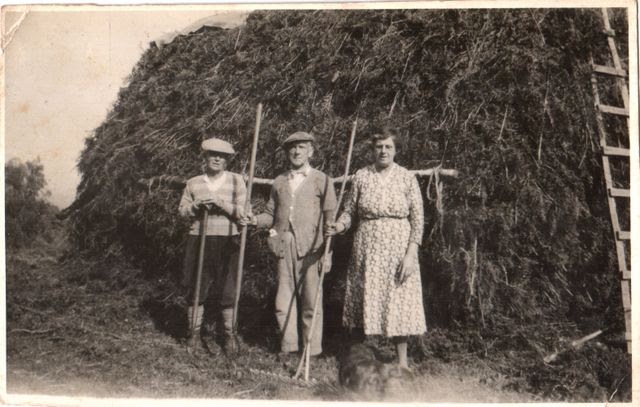
The following photographs have been supplied form the personal records of Bob Dean (Grandson of George Watson and Margaret Ann Nesbit Watson ( Nee Potts). George Watson and Margaret Watson moved to Older Hill after leaving Esh Winning in c1926. George Watson was a safety officer at Esh Winning Coal mine and required to go into the mines each day and ensure they were safe to return to when the strike would eventually finish. He was called scab by fellow workers and had to be protected by local police each time he entered and left the mine.
Eventually the strain was too much and the family moved to Older Hill, when old enough the children were put into service (Mary Watson later to become Mary Dean) went to Bournemouth as scullery maid.
Roger Lovett interviews Bob Dean, whose grandparents George and Margaret Watson lived at Older Hill, Redford, from the late 1930’s up to the mid 1950’s. Bob has been living in Australia for the past half a century but came back to Older Hill to visit his old haunts after 55 years. Roger asked him for his impressions and thoughts on how much he remembered from the 1950’s. Bob hopes to return in three years’ time: how much will Older Hill have changed by then?
Can you tell us how you came to be associated with Older Hill and Redford?
My late grandparents George Watson and Margaret Anne Nesbit Potts, were married at Waterhouses (Near Durham) in 1909, Pop was in the coal mine at Waterhouses and Nan’s father was the undermanager at the mine.
Pop had to attend to dewatering the site and other safety requirements during a miners strike. He was threatened by the coal miners as a scab and had to be escorted in and out of the mine by the police while the strike was on and even after it had ended. As a result he had a nervous breakdown and they decided to move to Older Hill, Redford.
Nan had an oil painting (I am told it was a Constable) that she sold to her family doctor and with the proceeds they bought Older Hill.
You now live in Sydney, Australia?
Yes, I migrated to Sydney in 1963, aged 18 as part of the assisted migration scheme to Australia. I only returned to the UK for the first time in July of 2013 (50 years later).
How long is it since you last visited Older Hill?
It was approximately 55 years since I was last there, Nan and Pop sold and moved away to Petersfield in about 1957 from memory. I am trying to get the exact date of when they sold the property for my records.
How much has the place changed?
Incredibly, not very much at all, when I came back and met with Rod Meikle and yourself and walked around the area, I was very surprised how little had actually changed, the old house was almost identical to when I was last there, how I remember it and from the pictures that the family had.
The road up to Older Hill was still the same, and in the same condition, I still recall Pop taking me for a ride in his horse drawn Sulky along the sand covered road.
The old front fence was no longer there and there had been some building work around the rear of the property. The old thunder box was no longer there and had been moved inside the house.
The old stepladder that was in place to get upstairs had been moved to allow a proper set of stairs to go in. The old holly bush was still outside the rear door and the sheds adjoining the house were still there. I felt as if I had been transported in time.
The old garage and Post Office at Redford were exactly the same, except for the modern cars. Inside the Post Office the large bins of wheat and bran were no longer there, otherwise it was if time had stood still.
How did your grandparents earn a living?
Pop had a horse and dray and a sulky, and along with being a common carrier, they also used to harvest the bracken and sold it for animal bedding. They grew their own vegetables and kept the normal farm animals, I recall they had a great gooseberry bush and a blackberry bush up the back yard. Nan’s gooseberry pies were just the best.
What are your fondest memories of Older Hill?
I have many pleasant memories of Older Hill, as I thought the world of my Nan although she was a hard woman by all accounts. When I returned in 2013, I talked to people who recalled Nan and Pop living there, and apparently Nan could be heard laying down the law all over Older Hill and down to Redford. No mean feat in days when they did not have any amplification equipment! But the scene I remember most clearly is captured by the photo where my Mum has a saucepan lid on her head and is sitting with Nan and Pop and Aunty and cousins.
How did they light the place at night?
There was no electricity or sewage when they owned it, so each night they would light up a kerosene lamp, and they would sit around and talk, or ask me to sing a song. When the kerosene ran out that was the time to go to bed.
You have a number of pictures that range from around the 1933 period onwards?
Yes, and I have supplied you with digital copies of those pictures. Please feel free to publish them, with the correct reference.
GALLERY: Woolbeding retains firm grip on rural way of life
There can be few more remote corners of West Sussex than Woolbeding with Redford. This long, thin parish crosses the A272 at one end where it borders Bepton and Midhurst and stretches the other end almost as far as Linch church. Up a dozen dirt tracks, criss-crossed with footpaths, through woodland and over Woolbeding and Pound Commons, are scattered many of the 67 households in the parish, an area where time really has stood still.
But if the word goes out about the Christmas party or the parish meeting, people start coming out of the woodwork and filling the village hall. For yes, this is a community which is alive and willing to fight to preserve its way of life.
There was an outcry when the National Trust, which owns a huge proportion of the parish, proposed fencing Woolbeding and Pound Commons for grazing in 1999. Locals were incensed at the prospect because the commons had always been enjoyed as an open amenity for the entire parish. They won that battle when five years ago the National Trust bowed to the protests and brought in more traditional grazing methods.
There was another outcry when Woolbeding with Redford suddenly found itself outside the proposed boundaries of the South Downs National Park. Believing it had to be inside the boundary to preserve its way of life, parishioners went into action again, preparing a strong case and appearing before the inspector at the public inquiry. But they still wait to find out whether they have won this battle.
By far the biggest landowner in the parish is the National Trust and Simon Craig is head warden of the West Sussex Downs (west) section, based at Pound Common Estate Office. “We own 1,000 acres in the parish of which Pound and Woolbeding Commons take up 450 acres and the rest is farmland,” he said. “Much of our work centres around forestry management and heathland management and restoration, access and nature conservation as well as leading school groups and guided walks.” Simon also attends parish council meetings. “This is a cracking place,” he said. “The one thing we lack is a village pub, but generally people are very supportive of and interested in their local community.”
It’s probably true that Woolbeding with Redford was a more vibrant place when the pub, The Plough, was in its heyday. Although that was many years ago, there are a few villagers around who still remember where it stood. When it was finally pulled down, a bungalow was built in its place which became home to Alice Lascelles, the daughter of the last private owner of Woolbeding House and estate, and her mother. After her death the bungalow was demolished and in its place is the large private home which still retains the name The Plough.
Rod Meikle has lived on Woolbeding Common for nearly 40 years. Until five years ago he ran Older Hill Kennels and he has been on the parish council for 35 years. “The pub had closed before I moved here,” he said. “It used to be one of those small Sussex beerhouse kind of pubs with an enormous fireplace. It had a reputation far and wide and was very popular.” Indeed it was the home of the village cricket team, which played on a ground which is now a field, and a regular village fete took place on the green in front of the pub.
“It was a vibrant little village,” added Karen Lovett, who has lived in the parish for 25 years. “But that was a long time ago and life has changed.”
The village school closed down in the 1950s and children travelled to the old primary school at Midhurst, close to the Half Moon pub. St Cuthmans, a special school which although it officially stood on the edge of Stedham parish had strong links with Woolbeding and Redford, has also disappeared and made way for another house. “It was very sad when it closed,” said Mr Meikle, “because it had strong connections with our parish, the children used the common for walks and we used to take them at the kennels when they wanted work experence.”
There is still a village shop at Redford where James and Jenny Williams have a raft of exciting new plans in the pipeline to generate new trade. But the parish lost its fight to keep the post office at the shop and now, like many other rural areas, it has to make do with what the post office likes to call an ‘outreach solution’.
Sadly Woolbeding lost one of its last businesses only last month when all the riding equipment and furniture of the Liverton family went under the hammer at Pound Farm. Martin Liverton and his wife Jane had to move out when the family’s lease expired at the farm. Sixty-one-year-old Martin was born at Pound Farm and was brought up there with his two sisters, Christine and Val. Their parents, Ken and Vera, had lived there since 1943. When farming hit hard times Jane set up the riding school 22 years ago. Martin, like his father before him, served on the parish council and his sister Christine was clerk for 19 years.
Now Redford Stores and the garage across the road are the only businesses left in the parish. Rodney Purver has been repairing cars there for 28 years, for the first 20 with business partner John Whiting. With car parts and tyres piled up to the rafters and ivy creeping in under the roof, there can be few quainter old businesses for miles around. Rodney gave up selling petrol five years ago, when price wars made it impossible, but the old pumps still stand on the roadside.
There is no doubt the focal point of village life is now the village hall. It was built in 1958 on land given by Alice Lascelles. The land is now owned by the National Trust and the hall by an independent committee chaired by Penny Caulfield. Currently undergoing upgrading work, it is home to keep fit, a playgroup, fundraising activities, parish council meetings, art and craft shows as well as the new monthly markets. These were set up by Zinnia Coolbear, Mrs Caulfield and Jenny Williams from the village shop.
Mrs Coolbear has lived in the parish for 18 years and is one of the team who roll up their sleeves and get stuck in when there is anything that needs doing, particularly at the village hall. The market was set up, she said, as a way of revitalising the village and getting the community together. “It has been going since May and we are always looking for new stallholders,” she said. “We have people selling produce, preserves and all sorts of things and the idea is the money raised goes back into the village hall.” The village hall has suffered from new brick-built competitors in other parts of the district and parishioners hope the upgrade will bring back people from outside the area. “We are giving it a year to see how people respond,” said Mrs Coolbear. “So far it is well-supported and we are happy.”
Church life is strong with around 20 people attending the little church of All Hallows at Woolbeding every week from a population of 50 in the ecclesiastical boundary. “We draw people who like the old-fashioned book of prayer,” said John Andre, who was married in the church 40 years ago and now serves on the parochial church council. “We have no electricity and so it’s candlelight and gas heaters – we don’t want electricity and if anyone suggested it, I think there would be an explosion.”
So is the parish thriving? It is generally agreed the age of the population is changing. There are people in their 90s who still live in the home they were born in, but there has been an influx of younger, wealthier people in recent years and there is a healthy population of children.
But as ever, affordable housing is scarce and although there are younger people who would love to stay, there are only two units available for rent and these hardly ever change hands.
“It’s probably the same in many places,” said Mrs Lovett. “If an event is organised, people do turn out and they are always great fun, but it’s getting people to volunteer…”